Before the Plot, There’s Pressure.
A scene doesn’t become interesting just because something happens.
It becomes interesting when something is pressing on the character while it happens.
A woman making coffee is an action.
A woman making coffee while rehearsing how to ask for time off before her mother’s surgery has pressure.
That pressure may be emotional, practical, social, or moral. It is the hidden burden underneath the visible task.
In fiction, ordinary actions can carry enormous weight when the reader senses what the character is trying not to face.
A scene does not become interesting just because something happens.
A character can pour coffee, drive home, sit in a classroom, fold laundry, or wait in line at a pharmacy; so what? On the surface, these are ordinary actions. Boring even.
But ordinary actions can become meaningful when they carry pressure beneath them. Pressure is the force pushing against a character during a scene.
It is the worry, the secret, the fear, or the need to make an impossible decision pressing on the character as they try to get through the moment.
That pressure could be emotional: A woman makes coffee while rehearsing how to tell her boss she needs time off for her mother’s surgery.
It could be practical: A man drives home after losing his job, knowing the rent is already late.
It could be social: A teenager sits at lunch, hoping no one notices she has nowhere to sit.
It could be moral: A character waits for a friend, knowing the friend is about to lie to them.
The action itself could be simple. The pressure has to give that action weight and purpose.
A Scene Needs More Than Movement
One mistake newer writers sometimes make is assuming movement automatically creates tension.
Someone runs.
Someone cries.
Someone slams a door.
Someone answers the phone.
Those things can be dramatic, but they do not guarantee the reader will care. A scene works better when we understand, or at least sense, what the moment costs the character.
What are they afraid will happen?
What are they trying not to say?
What are they hoping no one notices?
What truth are they avoiding?
Pressure gives the reader a reason to lean closer. It tells us that the scene matters, even if the room is quiet.
Visible Task, Invisible Burden
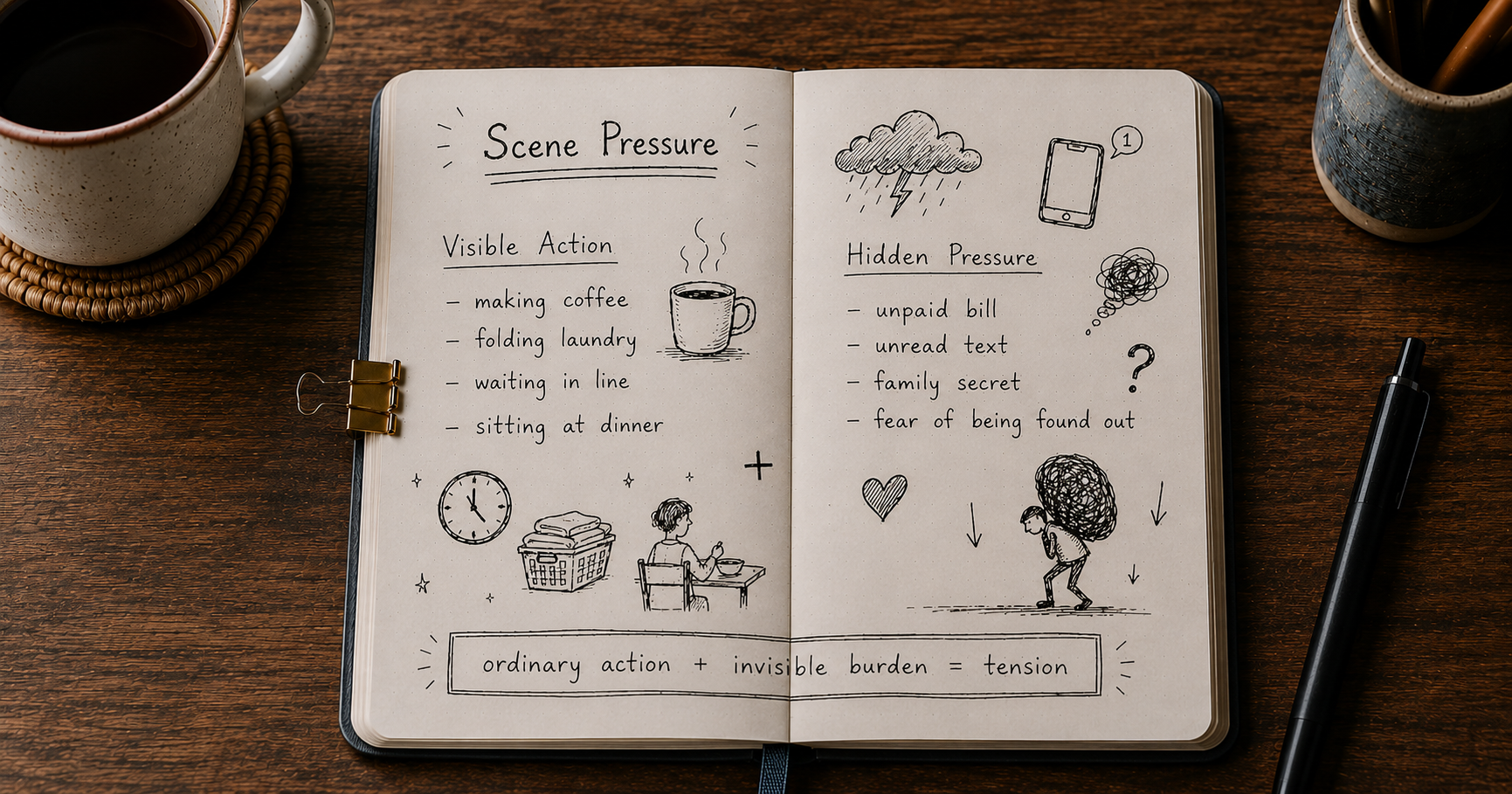
A helpful way to think about scene pressure is this: Give the character a visible task and an invisible burden. The visible task is what we can see the character doing. The invisible burden is what they are carrying while they do it. For example:
Visible task: A woman folds laundry.
Invisible burden: Her husband has not come home, and she is folding his shirts because she does not know what else to do with her hands.
Visible task: A man waits in line at the pharmacy.
Invisible burden: He is picking up medication he does not want anyone in town to know he needs.
Visible task: A child sits in class.
Invisible burden: The teacher asks students to read aloud, and the words keep moving across the page.
This combination can make even a small moment feel active. The character is not “just” folding laundry, waiting in line, or sitting in class. They are trying to stay composed. They are trying to delay something. They are trying to survive the next minute without panicking too soon. That is where the story starts to breathe.
Let Pressure Affect the Surface
Pressure should not only exist in the writer’s mind. It needs to show up somewhere on the page. Not always loudly. Not always through explanation. Sometimes, pressure is most effective when it leaks through small actions. A character might:
wipe the same counter twice
check their phone and then turn it face down
answer too quickly
laugh at the wrong moment
keep busy so they do not have to speak
Notice the exit before they notice the people in the room
These details matter because pressure changes behavior. A guilty character could hear accusation in a harmless question. A grieving character could notice ordinary objects that suddenly feel painful. An anxious character could pay attention to time, exits, noises, and pauses. A lonely character could read too much meaning into a small kindness. The scene world is not neutral. The character’s pressure changes what they notice.
How to Find the Pressure in a Scene
Before writing or revising a scene, try asking one simple question: What is pressing on this character right now?
Not in the whole book. Not in the entire plot. Right now, in this scene. Then narrow it further:
What does the character want?
What are they trying to avoid?
What would make this moment harder?
What would change the room if someone said it out loud?
What are they doing instead of saying what they really feel?
You do not need to answer all of these. One strong answer is enough to sharpen a scene. For example, “She is making dinner” becomes more specific when we add pressure:
She is making dinner while waiting for her son to come home after a fight. Now the chopping, stirring, and setting of plates can carry meaning. The ordinary actions have something underneath them.
A Quick Practice
Choose a plain action:
A character cleans a room.
A character waits for a bus.
A character makes breakfast.
A character walks into work.
A character answers a text.
Now add one invisible burden.
What are they afraid of?
What are they hiding?
What are they delaying?
What do they need but cannot ask for?
Then write the scene without immediately announcing the pressure. Let it show through what the character notices, avoids, touches, repeats, or cannot bring themselves to say.
A story does not always need to begin with a dramatic event. Sometimes it begins with someone trying very hard to act normal. And the pressure underneath that effort is what makes the scene move.
Lost Without a Map: The Importance of Having a Plan
I need a map before I start, and honestly, my writing is the same way. A loose story outline does not have to trap you. It can simply give your draft direction, purpose, and enough structure to keep going.
I don’t know about you, but I need a map! I need to know where I am going before I leave the house, or I’ll get lost. I have absolutely no sense of direction! And I can promise, as soon as I get lost, I will turn around and go home in a huff of anxiety and frustration.
Hilarious, right? And I know I am not the only one! And if I’m being honest with myself, I’m the same way as a writer. I need a roadmap. We can have big ideas swirling in our heads, but get lost in the process of trying to get them onto paper. If you read one of my older posts, “Stop Stalling,” then you know how I feel about writing without knowing how the story ends. Start without the ending if that’s what it takes for you to get started. Don’t use not knowing as an excuse to not do it.
But, if you’re like me, and you need a map, here's a truth for you: there are no strict rules for plotting your story. It doesn’t have to be as detailed as a real map. In fact, story plots are just a guide, an outline, and guess what? You don’t need to know the ending to draft one. As a matter of fact, I have purposely deviated from an original plotline just to see what kind of trouble my character could end up in (plot twists). So, despite the claims that plotting your story can make it boring or too textbook, remember: it is just a tool to help keep you organized.
Why This Matters
Even a loose map that’s missing the ending can keep you steady and curious about the journey your character makes. Jotting a beginning, one or two midpoints, and a few scenes you want to see prevents your draft from wandering into aimless territory. It shows you which scenes matter and which will be distractions. A short outline turns a huge, vague project into tiny, doable tasks you can chip away at all night or -for my parents and 12-hour shift workers- in five or ten-minute bursts. It also makes it easier to spot logic holes or pacing problems before they become discouraging mountains.
A Classic Technique
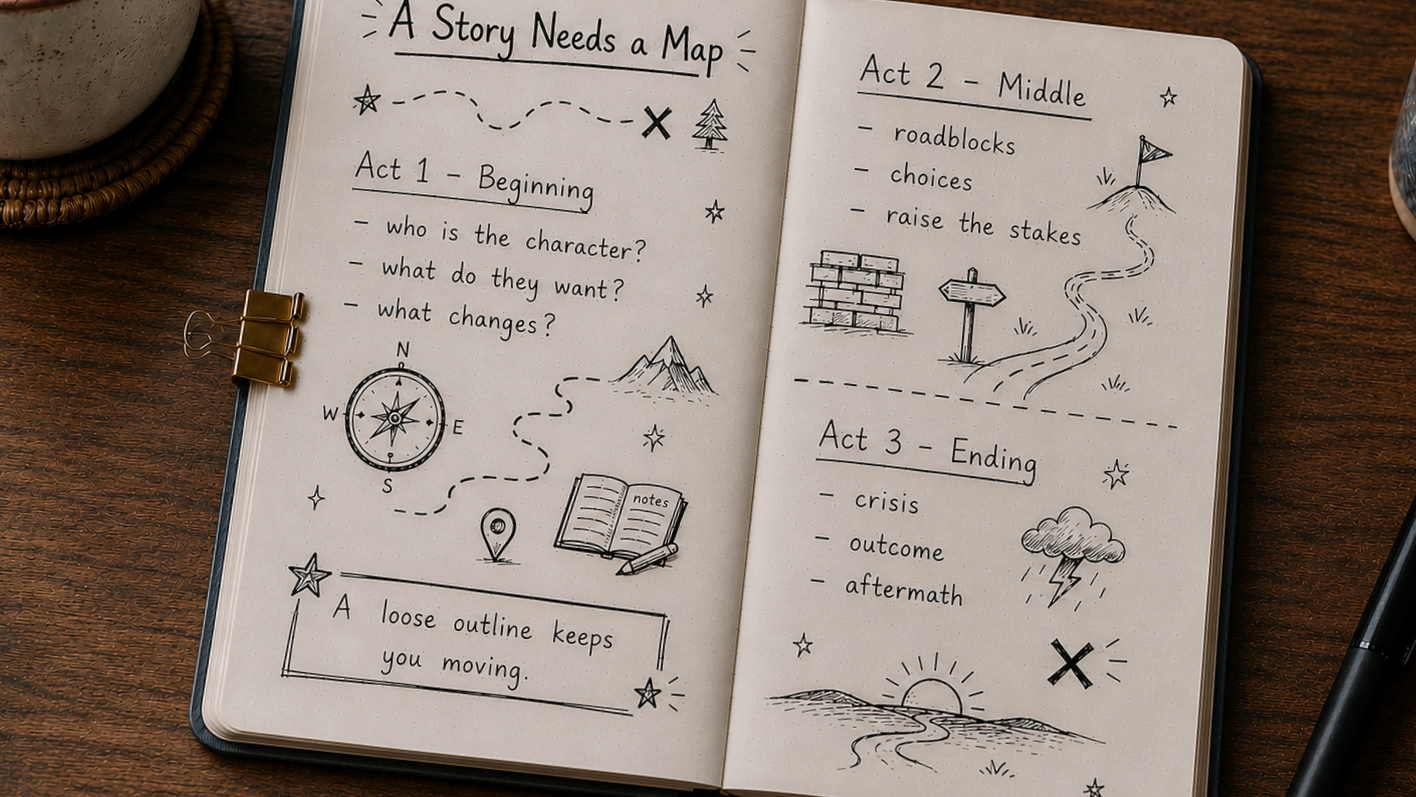
Here is a method I’ve used time and time again: the Three-Act Structure. Here is a quick breakdown:
Act 1: Setup – Beginning, Inciting Incident, Second Thoughts, Plot Point One
Act 2: Confrontation – Rising Action, Midpoint, Plot Point Two
Act 3: Resolution – Pre-Crisis, Crisis, Failing Action
Act I
The exposition (introduction) is all about setting the stage: who is your protagonist? What’s missing in their life right now? What is their greatest desire? Depending on how many characters your story has (and the roles they play), this is also the place to make at least ⅔ of your characters ’ introductions.
The inciting incident is the catalyst that sets the protagonist’s adventure in motion. This step proposes or triggers a journey for the protagonist that could help them change their situation and achieve their goal.
The First Plot Point represents the protagonist’s decision to engage with whatever action the inciting incident has triggered. Think about The Hobbit: plot point 1 is when Bilbo Baggins decides to join Gandalf and the band of dwarves for an epic adventure.
Note: your ‘inciting incident’ and ‘plot point 1’ can happen in one full swoop.Act II
This is typically the longest section, the journey itself, and the protagonist’s arrival at the crisis point. Here, during the ‘rising action, is where the protagonist’s journey begins and where they first encounter roadblocks. This is also the part of the story where you should better acquaint readers with the rest of the cast, all remaining characters not previously introduced, and the primary antagonist(s)
Note: the antagonist’s doesn’t have to be a person, specifically, but I’ll get into that another time.The Second Plot Point is where your poor protagonist has fallen on hard times. Here, feelings of defeat flood in from all the other roadblocks they’ve already faced. But, it wouldn’t be much of a story if they quit here, now, would it?
Act III
Pre-Climax: Your protagonist has been gearing up to meet the antagonist head-on; their main foe has also been getting stronger and is now ready for “battle.”
The Climax signifies the final moments of your protagonists’ fight to reach their goal. The antagonist has wounded your protagonist already, but they must face off again. The conflict must end one way or another. Your protagonist either reaches the goal… or they fail.
The dust settles in the failing action phase. If the protagonist’s end result is not immediately shown during the climax, the failing action is where this should become apparent to the readers.
Final Takeaway:
Plotting is less about knowing every twist and more about noticing the threads already around you. The benefit of using a plotting technique like the three-act structure is that it helps you start and end each scene with a clear purpose and direction. Plotting doesn’t have to be rigid. You don’t have to fill in every single detail in your outline. You only need the bare minimum. And you don’t even need to know how it ends yet. But you can get started with a guide. Start today. Why not?
A Story in Three Acts (Even When It’s Only 100 Words)
Writers hear about the three-act structure pretty often, or at least I did when I was in college. It’s one of the oldest storytelling frameworks we have. Aristotle wrote about the idea many lifetimes ago: stories must have a beginning, middle, and end.
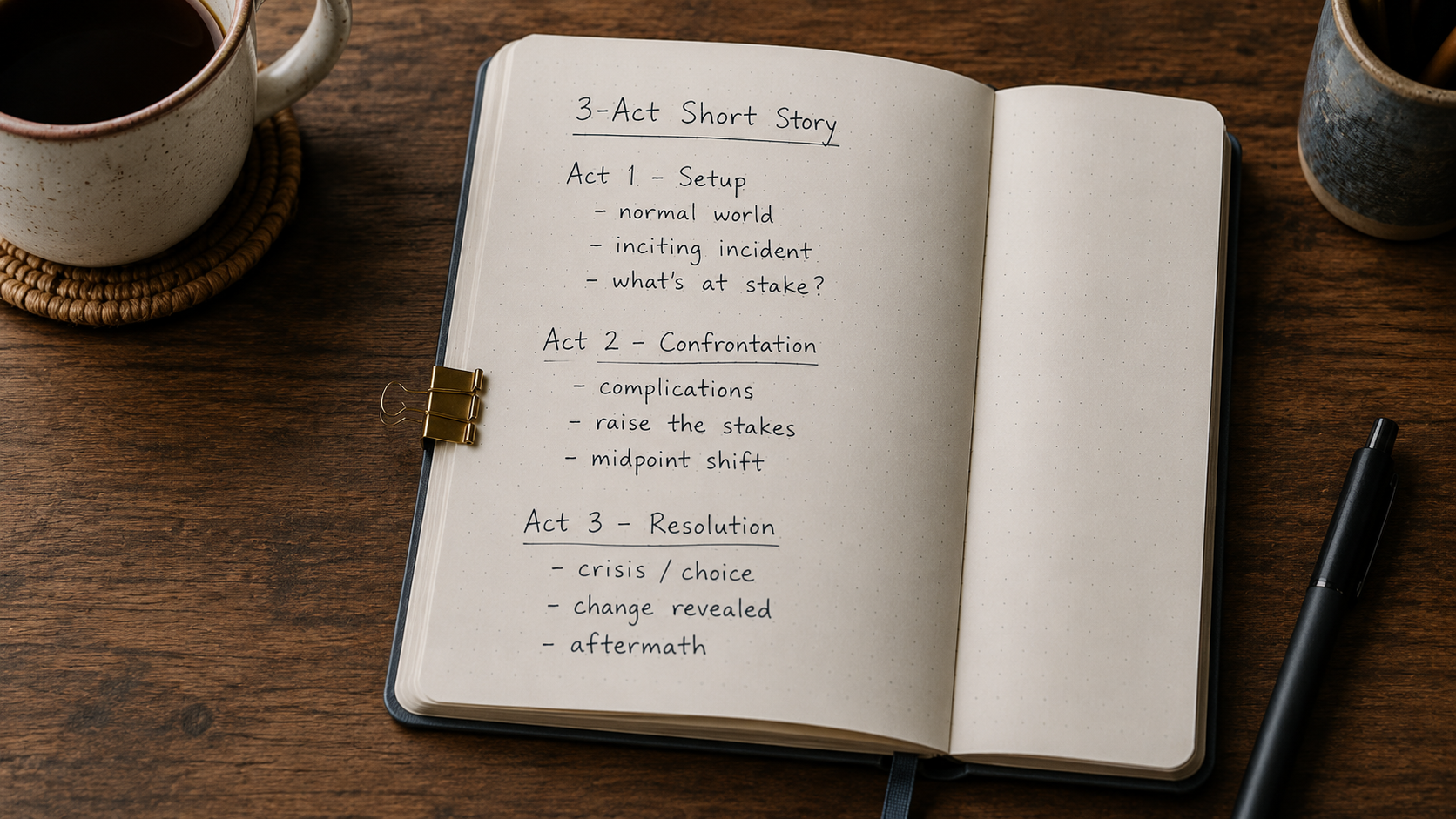
In practical terms, the three-act structure looks like this:
Writers hear about the three-act structure pretty often, or at least I did when I was in college. It’s one of the oldest storytelling frameworks we have. Aristotle wrote about the idea many lifetimes ago: stories must have a beginning, middle, and end.
In practical terms, the three-act structure looks like this:
Act I – Setup (something changes)
Act II – Rising tension (the character moves deeper into the problem)
Act III – Resolution or revelation (something shifts or is revealed)
You don’t need a long novel to use it. Even very short fiction works better when something moves.
Let me show you what I mean…
Act I – The Setup
Act I introduces the situation and creates the first disturbance. Something small but unsettling happens, making the reader lean forward. A lot of beginners are tripped up in the early stages with too much exposition and history, but it’s more important to start a story in the middle of a disturbance in your character’s life (especially for short stories).
Story – Act I:
Mara noticed the door before she parked.
Her front door stood a few inches open, the brass handle catching the late afternoon light. She was certain she’d locked it that morning.
What does this act do? It makes readers lean in and ask, "Why is the door open?”
Act II – Rising Tension
Act II is when the character moves toward the problem rather than away from it. The tension increases because the character doesn’t yet understand what’s wrong. Readers begin anticipating danger.
Story – Act II:
For a moment, she stayed in the car, engine running. Then she heard it. Her dog barking.
“Scout?” she called, stepping onto the porch. The door creaked as she pushed it open. The barking stopped. The house was suddenly quiet.
Act III – The Turn
Act III delivers the shift. Something happens that changes the reader’s understanding of the situation. In micro fiction, this moment is often the final line.
Story – Act III
“Scout?” she called again.
A voice answered from the hallway, “Who’s Scout?”
Mara froze. The hallway light flicked on.
A man stepped into view, “Oh,” he said. “You live here.”
In micro fiction such as this, that revelation often ends the story. A seemingly unfamiliar man is standing in Mara’s home, and the reader is left to imagine what happened next.
But in longer fiction, this three-act structure is broken into more subpoints, something like this:
Act I — Setup
Introduction – We meet the character and their normal world.
Inciting Incident – Something disrupts that normal life.
Act II — Confrontation
Rising Conflict – The character tries to deal with the problem, but obstacles and tension increase. (Often, more subpoints follow this subpoint)
Act III — Resolution
Climax – The central conflict is confronted.
The original ending for this story is typically the beginning of the climax in longer fiction. For longer pieces, the story might continue like this (and go further on):
“Oh,” he said. “You live here.”
Scout burst from the bedroom behind him, barking wildly. The man flinched. And Mara realized something worse than a break-in was happening now. He hadn’t expected anyone to come home.
Why This Structure Works
The three-act structure works because it mirrors how we experience tension in real life:
Something unusual happens.
We move closer to understand it.
The truth is revealed.
Even in 100 words, a story becomes stronger when it moves through those stages. Without movement, a piece often feels like a paused moment. With movement, it becomes a story. Sometimes all it takes is one open door.